Tuesday, 7 August 2012

2/2/2012: Amman, Jordan

in Irbid>
Met Mu'ez. my younger brother
Ju met her friend
I called my long-time-no-see friend/ my bff during i was 15 yrs =),, Adnin -7 yrs not meet u! miss u so much
she said i'm not change so much. =)
We met at Arabella @ Arabia Mall, not sure the name...
Oh before that, wait for Mu'ez and Amin (relative of Min) came, waiting at restaurant..

went to Amman
for sightseeing & shopping..souveniers
t-shirts for family. key-chain, etc..

have dinner here. city mall @Amman
to my guy, eh tp ni saje ambik pic, xde kaitn dgn sape2 :P.banyak kad cantik2.sgt3. tapi 7 dinar okeyh sekeping=RM28=Le56!! OMG @hallmark

Amman

ni bukan kat Amman, tapi Mafraq, kitorg bukan stay kat hotel, tapi asrama, bajet3..wew

29/1/2012 late night: Mu'tah, Jordan

.dropped by Mu'tah
only few hours here
to visit maqam, and sleep,yeay

**visit Mu'tah before arrived at Petra, just after the day after Dead Sea-day and Mount Nebo (entries before)

very COLD here
at night reach -1c
and after we leave Mu'tah that morning, my friend said in Mu'tah was snowing..OMG...terlepas nak main salji!

Mu'tah (Arabic: مؤتة) is a town in Karak Governorate in Jordan. It is known for the Battle of Mu'tah in 629 AD, the first military engagement between the Arab muslims and the Byzantine Empire. Mu'tah University is located in the city.


I found Malay language here!!

Mosque area

maQam


Mobilization of the armies

According to later Muslim historians, Muhammad dispatched 3,000 of his troops to the area in Jumada al-awwal of the year 8 A.H., i.e., A.D. 629, for a quick expedition to attack and punish the tribes. The army was led by Zayd ibn Haritha; the second-in-command was Jafar ibn Abi Talib and the third-in-command was Abdullah ibn Rawahah.[7]

The leader of the Ghassanids is said to have received word of the expedition and prepared his forces; he also sent to the Byzantines for aid. Muslim historians report that the Byzantine emperor Heraclius gathered an army and hurried to the aid of his Arab allies. Other sources say that the leader was the emperor's brother, Theodorus.[citation needed] The combined force of Roman soldiers and Arab allies is usually reported to be approximately 200,000.

When the Muslim troops arrived at the area to the east of Jordan and learnt of the size of the Byzantine army, they wanted to wait and send for reinforcements from Medina. Abdullah ibn Rawahah scolded them for their timidity, so they continued marching towards the waiting army.

The battle

The Muslims engaged the Byzantines at their camp by the village of Musharif and then withdrew towards Mu'tah. It was here that the two armies fought. Some Muslim sources report that the battle was fought in a valley between two heights, which negated the Byzantines their numerical superiority. During the battle, all three Muslim leaders fell one after the other as they took command of the force: first, Zayd ibn Haritha, then Jafar ibn Abi Talib, then Abdullah ibn Rawahah. Al-Bukhari reported that there were fifty stab wounds in Jafar's body, none of them in the back. After the death of the latter, some of the Muslim soldiers began to rout. Thabit ibn Al-Arqam, seeing the desperate state of the Muslim forces, took up the banner and rallied his comrades, and managed to save the army from complete destruction. After the battle the troops asked Thabit ibn Al-Arqam to assume command; however, he declined and asked Khalid ibn al-Walid to take the lead.[7]

Khalid ibn Al-Walid reported that the fighting was so intense that he used nine swords which broke in the battle. Khalid, seeing that the situation was hopeless, prepared to withdraw. He continued to engage the Byzantines in skirmishes, but avoided pitched battle. One night he completely changed his troop positions and brought forth a rearguard that he had equipped with new banners; all this was intended to give the impression that reinforcements had arrived from Medina. He also ordered his cavalry to retreat behind a hill during the night, hiding their movements, and then to return during daytime when the battle resumed, raising as much dust as they could. This also was intended to create the impression that further reinforcements were arriving. The Byzantines believed in the fictitious reinforcements and withdrew, thus allowing the Muslim force to safely retreat to Medina.

Military commentators on the battle have often praised the skirmishing tactics of Khalid ibn al-Walid.[10][7]
Aftermath
Medina, the Muslim capital.

It is reported that when the Muslim force arrived at Medina, they were berated for apparently withdrawing and accused of fleeing. Salamah ibn Hisham is reported to have prayed at home rather than going to the mosque to avoid having to explain himself. Muhammad ordered them to stop, saying that they would return to fight the Byzantines again and bestowed upon Khalid the title of 'Saifullah' meaning 'The Sword of Allah'.

Today, Muslims who fell at the battle are considered martyrs (shahid). Some have claimed that this battle, far from being a defeat, was a strategic success; the Muslims had challenged the Byzantines and had made their presence felt amongst the Arab Bedouin tribes in the region. A mausoleum was later built at Mu'tah over their grave.[12]

The event is referenced in many Sunni Hadith collections. The Sahih al-Bukhari hadith collection mentions that 9 swords of Khalid ibn Walid were broken:
“ Narrated Khalid bin Al-Walid:

On the day of Mu'tah, nine swords were broken in my hand and only a Yemenite sword of mine remained in my hand.Sahih al-Bukhari, 5:59:565
”

It also mentions that Jafar should take over as commander if Zaid ibn Haritha was killed:
“ 'Abdullah bin 'Umar said, "Allah's Apostle appointed Zaid bin Haritha as the commander of the army during the Ghazwa of Mu'tah and said, "If Zaid is martyred, Ja'far should take over his position, and if Ja'far is martyred, 'Abdullah bin Rawaha should take over his position.' " 'Abdulla-h bin 'Umar further said, "I was present amongst them in that battle and we searched for Ja'far bin Abi Talib and found his body amongst the bodies of the martyred ones, and found over ninety wounds over his body, caused by stabs or shots (of arrows). Sahih al-Bukhari, 5:59:565 ”

The event is also referenced in the Abu Dawud hadith collection as follows:
“ My foster-father said to me - he was one of Banu Murrah ibn Awf, and he was present in that battle, the battle of Mu'tah: By Allah, as if I am seeing Ja'far who jumped from his reddish horse and hamstrung it; he then fought with the people until he was killed.Sunnan Abu Dawud, 14:2567

**kami lawat kat tempat perang tu, kawasan tu wangi sbb ramai syuhada' yg dikebumikan disitu
*tempat maQam2 ni pewangi-kasturi yg dibawa dari India

Allahuakbar...mereka da selamat syahid
dan dua nikmat yg paling nikmat atas dunia adalah: SYAHID & KHUSYUK dalam SOLAT


Monday, 6 August 2012

1/2/2012: Wadi Rum, Jordan


kami kat belakang tu!
membelek kisah Wadi Rum


Wadi Rum has been inhabited by many human cultures since prehistoric times, with many cultures–including the Nabateans–leaving their mark in the form of rock paintings, graffiti, and temples. As of 2007[update], several Bedouin tribes inhabit Rum and the surrounding area.
In the West, Wadi Rum may be best known for its connection with British officer T. E. Lawrence, who based his operations here during the Arab Revolt of 1917–18. In the 1980s one of the rock formations in Wadi Rum was named "The Seven Pillars of Wisdom" in memory of Lawrence's book penned in the aftermath of the war, though the 'Seven Pillars' referred to in the book actually have no connection with Rum.
The area centred on Wadi Rum (the main valley) is home to the Zalabia Bedouin who, working with climbers and trekkers, have made a success of developing eco-adventure tourism, now their main source of income. The area around Disi to the NE, home to the Zuweida Bedouin and erroneously also thought to be part of Wadi Rum by visitors, caters more for Jordanian visitors from Amman, with campsites regularly used by party-goers.

Petroglyphs

Khaz'ali Canyon in Wadi Rum is the site of petroglyphs etched into the cave walls depicting humans and antelopes dating back to the Thamudic times.
Petroglyphs in Wadi Rum

Tourism

The Wadi Rum Visitor Center
View from the top of Mount Rum
A Nabatean temple in Wadi Rum
The area is now also one of Jordan's important tourist destinations, and attracts an increasing number of foreign tourists, particularly trekkers and climbers, but also for camel and horse safari or simply day-trippers from Aqaba or Petra. In contrast, there are almost no local or Arab tourists though nearby Disi (not actually part of Rum) attracts young people from Amman at weekends.

see wikipedia for more pics n info =)

our activities here:
1- play with sand (the most finest sand in the world)
2- make sand a glider for us, but it was a failure ^_*
3- small cave. written on it Lailahaillallah
4-sunset- view
5-visit a small village there. about 1000 people live here
6-grave/tomb
7-Nabatean temple (only the remains of the building)


nak naik ke puncak


sangat berseni org dulu2

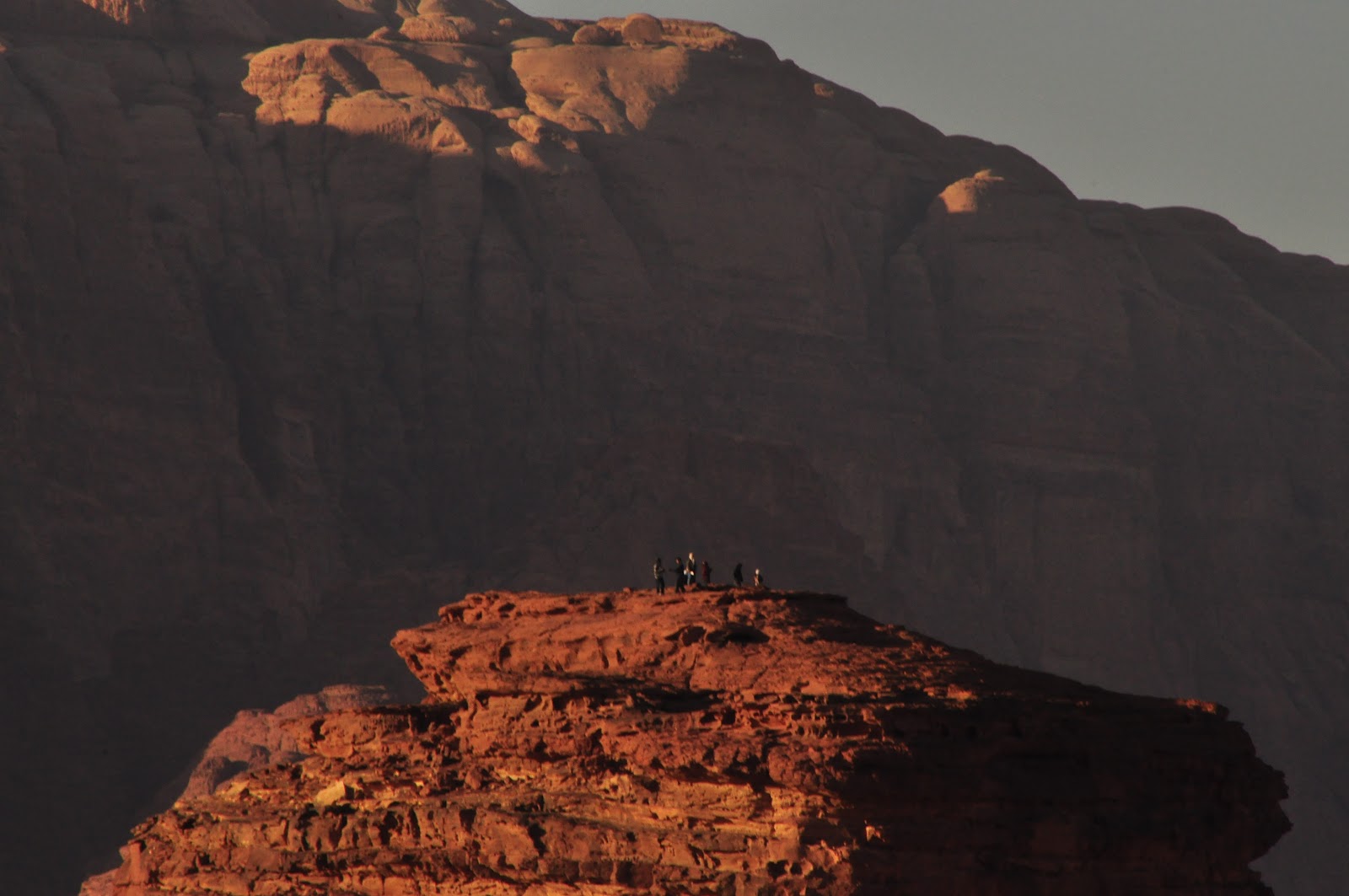
can u see? we are on top of the roCk?hill? =)

kami di puncak

nak gelungsur je,,tapi kan pasir tu pasir terhalus di dunia,, mmg xley gelungsur..huhu. murakib gelak kt kitorg ms ni


 credit: all pics from murakib. not my own camera =)

  
 Solat yang dikerjakan sebagai benteng gangguan syaitan untuk masuk ke rumah. Rasulullah bersabda maksudnya: “Jadikanlah solat sunat dalam rumah kamu dan janganlah jadikan rumah kamu itu sebagai kubur.” – (Riwayat Bukhari, Muslim dan Nawawi).

Maksud sebagai kubur itu adalah tidak melakukan solat sunat di rumah. Rasulullah selalu mengerjakan solat sunat di rumah sebelum solat fardu di masjid seperti sabdanya bermaksud: “Wahai manusia, solatlah kamu (sunat) di rumah kamu kerana sesungguhnya solat seseorang yang paling afdal adalah di rumahnya kecuali solat wajib.” – (Riwayat Nasai’).


31/1/2012: Aqabah, Jordan


assalamualaikum
ape kabar semua? =)
hari ni nak update pasal Jordan,,hehe

Aqabah
-malam-malam sampai dari Petra, memang penat sangat, tapi still boleh keluar malam lagi beli souvenier.*_* tapi sebelum tu check-in hotel dulu, dekat je dengan pantai, Hospitality Palace Hotel
-dekat hotel macam ade kedai-kedai, mostly jual baju. Sejuk jugak malam tu. Saya beli key-chain dan perhiasan rumah a.k.a sudu seramik yg gantung tu, jelly-bean, choc bentuk batu2, stoking, dalam kol 12 malam balik hotel. Ramai2 la, tentunya bersama murakib aka mushrif.


murakib kata kdg2 arab saje je letak benda pelik2 kat dasar laut,, nk buat mcm historical things la kununnye..ade jgk an cmtu*_@


kami berempat dari MEsir, yg lain kak senior pelajar dirasat, Jordan. diorang study kt unial-Bayt

kakak kpd Min, k.fatimah y bw beg tu

balik dari pantai nak tahan teksi ke China Town


8.00 pagi esoknya, kami naik bot kat pantai, sebenarnye an, sebelah sana nun nun nun tu, nun di sana tu, adalah tanah Mesir, hee, ade je orang Jordan gi Mesir nek bot, orgMesir pun ade je camtu..pantai Nuweiba, murah la sikit dari naik kapal terbang=)
Bersiar-siar kat pantai, snap few pics

Kami cari restoran. Saya beli falafel dan burger utk sarapan. Beli siap2 terus utk lunch nasi bukhari.. lebih kurang je rasa dgn nasi kat Mesir, tapi sedap lagi Jor kot..hihi
Lepas beberapa lama, kami tahan teksi untuk ke China Town.yes, ade China Town katsini.. klu kat Mesir ramai jugak pedagang berbangsa Cina jual pakaian..katsini aku tak beli ape2 pun sebab jimat bajet. Ade jugak teringin nak beli, tapi em, yg ni cam da ade kt mesir, so tak beli..harga lbh kurang..tak mahal n tak murah,,just reasonable la


Then kami bertolak ke Wadi Rum..entri seterusnye yepp!

>ade jugak page mcm ni kat laman sesawang facebook> page himpunan awek melayu bertudung. admin dy kumpul gambar2 perempuan melayu yg bertudung. perlu ke semua ni? hurm. bahaya bahaya~

30/1/2012: Petra,Jordan


*bercuti-cuti di Jordan bulan Februari lepas, tapi baru update..kiki

Petra (Greek "πέτρα" (petra), meaning stone; Arabic: البتراء, Al-Batrāʾ) is a historical and archaeological city in the Jordanian governorate of Ma'an that is famous for its rock cut architecture and water conduits system. Established sometime around the 6th century BC as the capital city of the Nabataeans,[2] it is a symbol of Jordan as well as its most visited tourist attraction.[2] It lies on the slope of Mount Hor[3] in a basin among the mountains which form the eastern flank of Arabah (Wadi Araba), the large valley running from the Dead Sea to the Gulf of Aqaba. Petra has been a UNESCO World Heritage Site since 1985.

The site remained unknown to the Western world until 1812, when it was introduced by Swiss explorer Johann Ludwig Burckhardt. It was described as "a rose-red city half as old as time" in a Newdigate Prize-winning poem by John William Burgon. UNESCO has described it as "one of the most precious cultural properties of man's cultural heritage".[4] Petra was chosen by the BBC as one of "the 40 places you have to see before you die".[5]
Pliny the Elder and other writers identify Petra as the capital of the Nabataeans, and the center of their caravan trade. Enclosed by towering rocks and watered by a perennial stream, Petra not only possessed the advantages of a fortress, but controlled the main commercial routes which passed through it to Gaza in the west, to Bosra and Damascus in the north, to Aqaba and Leuce Come on the Red Sea, and across the desert to the Persian Gulf.

ni kat mount nebo, bukan petra, post sebelum ni, ustaz sdg bg penerangan

yep ini petra


petra

Add caption

subhanallah...


lorong2 di bukit (mmg berbatu bukit2 ktsini)

Map of Petra
Excavations have demonstrated that it was the ability of the Nabataeans to control the water supply that led to the rise of the desert city, creating an artificial oasis. The area is visited by flash floods and archaeological evidence demonstrates the Nabataeans controlled these floods by the use of dams, cisterns and water conduits. These innovations stored water for prolonged periods of drought, and enabled the city to prosper from its sale.[6][7]
Although in ancient times Petra might have been approached from the south on a track leading around Jabal Haroun ("Aaron's Mountain"), across the plain of Petra, or possibly from the high plateau to the north, most modern visitors approach the site from the east. The impressive eastern entrance leads steeply down through a dark, narrow gorge (in places only 3–4 m (9.8–13 ft) wide) called the Siq ("the shaft"), a natural geological feature formed from a deep split in the sandstone rocks and serving as a waterway flowing into Wadi Musa. At the end of the narrow gorge stands Petra's most elaborate ruin, Al Khazneh (popularly known as "the Treasury"), hewn into the sandstone cliff.
A little further from the Treasury, at the foot of the mountain called en-Nejr, is a massive theatre, so placed as to bring the greatest number of tombs within view. At the point where the valley opens out into the plain, the site of the city is revealed with striking effect. The amphitheatre has been cut into the hillside and into several of the tombs during its construction. Rectangular gaps in the seating are still visible. Almost enclosing it on three sides are rose-coloured mountain walls, divided into groups by deep fissures, and lined with knobs cut from the rock in the form of towers.

[edit] History
Evidence suggests that settlements had begun in and around Petra in the eighteenth dynasty of Egypt (1550-1292 BC). It is listed in Egyptian campaign accounts and the Amarna letters as Pel, Sela or Seir. Though the city was founded relatively late, a sanctuary existed there since very ancient times. Stations 19 through 26 of the stations list of Exodus are places associated with Petra.[8] This part of the country was Biblically assigned to the Horites, the predecessors of the Edomites.[9] The habits of the original natives may have influenced the Nabataean custom of burying the dead and offering worship in half-excavated caves. Although Petra is usually identified with Sela which means a rock, the Biblical references[10] refer to it as "the cleft in the rock", referring to its entrance. The second book of Kings xiv. 7 seems to be more specific. In the parallel passage, however, Sela is understood to mean simply "the rock" (2 Chronicles xxv. 12, see LXX).

On the authority of Josephus (Antiquities of the Jews iv. 7, 1~ 4, 7) Eusebius and Jerome (Onom. sacr. 286, 71. 145, 9; 228, 55. 287, 94) assert that Rekem was the native name and Rekem appears in the Dead Sea Scrolls[11] as a prominent Edom site most closely describing Petra and associated with Mount Seir. But in the Aramaic versions Rekem is the name of Kadesh, implying that Josephus may have confused the two places. Sometimes the Aramaic versions give the form Rekem-Geya which recalls the name of the village El-ji, southeast of Petra.[citation needed] The Semitic name of the city, if not Sela, remains unknown. The passage in Diodorus Siculus (xix. 94–97) which describes the expeditions which Antigonus sent against the Nabataeans in 312 BC is understood to throw some light upon the history of Petra, but the "petra" referred to as a natural fortress and place of refuge cannot be a proper name and the description implies that the town was not yet in existence.

read more >> wikipedia..hehe =)
*da sampai akhir checkpoint,,still ade lagi gerai cenderamata..mmg gigih org katsini cari duit, kalau otw tu mmg byk juga la gerai2, kedai besar cam khemah gitu pun ade jual minuman/makanan ringan
*petra= peninggalan zaman Nabi Soleh
malamnya otw balik dari puncak ke tempat parking coaster, hujan renyai-renyai still tak berhenti..lama la jugak hujan ni, masa mula2 sampai ke Petra lagi,,huhu,sebab tu kitorang ramai-ramai beli rain coat, melayang 3 dinar, huhu, 3 dinar ni lbh kurang 12 ringgit  ..hehe..mahal lagi dr dolar us~

malam, memang penat sangat, teruskan perjalanan ke Aqabah dan menginap di salah sebuah hotel katsitu> entri seterusnya!! =)>>

see water & stone, hati-hati kan jatuh terkehel tak pasal2 ,,whehei =)

Friday, 3 August 2012

Pengalaman: Kos Medik melalui Kementerian/YIK

assalamualaikum readers!!


akhir-akhir ni ramai yang ingin melanjutkan pelajaran dalam bidang perubatan. mungkin ade yang pilih kos ni sebab minat ,mungkin jugak sebab ibu bapa yang menyuruh mereka ambik kos  ni ataupun sebab kerjaya ni nampak femes (famous)/ade peluang cerah/mudah dapat kerja. (banyak lagi sebenarnya kos best spt IT yang incomenye lbh besar berbanding jadi doktor,,doktor = kurang life)=)

sebenarnya sangat bagus kalau nak ambik kos kritikal macam ni dan negara pun amat memerlukan ahli perubatan. Antara cabaran yang akak (heee=) nampak sepanjang jadi pelajar perubatan ni bukannya mudah esp kepada sesiapa yang berminat sangat nak melanjutkan pelajaran ke Mesir. antara cabaran tu adalah dari segi bahasa, kemudahan dan kelengkapan belajar. bahasa tu takpe, kita boleh belajar la sikit2 lagipun pembelajaran dlm kelas mcm kat universiti zagazig/cairo/tanta/mansura/alex ni asing, kelas pelajar Melayu n kelas pelajar  Arab.

Kemudahan n kelengkapan tu kurang la. teknologi die kurang. contohnye, nak belajar anatomy bahagian larynx kan. kat sini, kurang  model-model patung untuk belajar anatomy tu,,tapi banyak yang betul-betul orang punye (cadaver-mayat). kekurangan belajar guna mayat ni tak nampak secara jelas n biasanye doktor akan ajar guna mayat utk bahagian abdomen, upper limb, lower limb,thorax..tapi untuk larynx takde..
lagi satu, mayat ni kuat la sikit bau formalin tu, kena  pakai glove la for sure, n takley g sorang-sorang, boleh je,kalau berani..hehe

yang tu akak nampak kurangnye universiti di Mesir ni,,haa, satu lagi kurang praktikal..skil2 kurang dipelajari kat sini sebab tu pelajar Mesir sangat-sangat digalakkan untuk buat attachment semasa cuti musim panas di Malaysia.. emm kalau nak diagnose penyakit pun maybe tahun 3 tu da boleh ar sket2..insyaallah..

kelebihan kat Mesir ni, banyak belajar teori. kitorang pun kena hafal banyak benda jugalah n kalau boleh hafal sebijik macam buku...wehehei..esp subjek ringan seperti psikologi (tahun 2)..kalau tempat lain, tak kisah sangat psl sebijik mcm buku ke tak, asalkan konsep tu betul. tapi kalau akak sendiri, lebih suka guna nota masa lecture tu+buku yang dikeluarkan oleh universiti+international books

ok berbalik pada tajuk,
(pengalaman akak dulu2)
kalau nak datang melalui Kemeterian Pelajaran Tinggi Malaysia, perlulah skor dalam SPM sekurang2nya 8A dan sekurang2nya B untuk mata pelajaran sains (FIzik, Kimia,Biologi)..akak dapat 10A,2B- SPM 2007 (EST B sbb tak berapa minat, Fizik B sbb tertinggal soalan<*_*~>

lepas tu isi borang, dan proses ambil masa dalam 2 bulan jugak..calon2 akan dikaji/ditapis.. selalulah berhubung dgn pihak KPT, tanya apekah status anda skg, =)
kalau akak dulu akak isi borang melalui yayasan islam kelantan(YIK), bayar dlm rm300 kot untuk yayasan proses kan dan hantar kepada KPT. kalau kerajaan negeri lain da guna sistem MoU ,,tapi kalau YIK ni selalunya akan letak bawah program G2G (government to government)
ade kekurangan la kalau letak bawah G2G,sebabnya fail kita tu macam chipsmore. macam tak konfem betul ke awak dapat universiti yang da diberitahu oleh KPT Malaysia @ KPT Mesir..tapi kalau MoU nye program, da tentu fail u akan sampai kat universiti yang dimaklumkan tu,,tapi wallahu'alam la sebabnya urusan dgn pihak Arab ni agak susah sikit..huhu ..kelebihan G2G pulak,yuran dy berkali ganda murah berbanding program MoU.. selalunya agen kalau hantar diorang pakai MoU nye program la..which is rm29000 setahun..tapi kalau yuran tuk G2G lagi2 murah la..

bila da dapat surat dari KPT, (akak mmg dapat universiti Zagazig sejak dari Malaysia,dan KPT Mesir pun tak tukar akak ke mana-mana, so stay je Zagazig,,actually akak tak apply pun zagazig,,apply cairo,alex,mansura,,wahaha,,tapi maybe tempat tu da full,so kena datang sini la..

lepas tu, siap2 semua, akak tak dapat mana2 bantuan pengajian masa tahun 1, sebab YAKIN(associated with YIK) akan bagi bantuan pelajaran kepada orang yang betul2 susah je..ni masa akak gi interview,,orang katsana tanya "anak Encik Mahmood kan,yang keje kat bank tu? o da duit banyak kan?" huhu,,,senyum kambing je sambil jawab, encik, en mahmood tu memang ayah saya tapi bank tu bukan kami yang punyer..huhu..aku pun keluar bilik,, sugul dan keciwaa..actually masa ni aku stay umah nenek, tumpang keta uncle. uncle pecut laju gile dari tanah merah ke kota bharu semata-mata nak interview,,tapi tak pela,,nak wat camne, bukan rezeki aku, lagipun perlu ingat ramai lagi yang lagi susah dari aku...

bila tiket flight da dibeli,,gi la KLIA, waa ramainye orang..anak-anak kelantan (bawah YIK), medik n pelajar jurusan agama(dirasat),,diorang diberitahu pakai kot, aku plop gi pakai jaket sejuk warna pink,,huhu,,tak tahu la plak kena pakai kot..hurm

ok, sampai ke Mesir, maka katsini la bermulanya titik2 kehidupan..
aku tinggal selama sebulan dekat rumah kelantan di Mesir (RKB), dalam tempoh tu akak dan kawan-kawan yang lain pergi belajar kat universiti terdekat iaitu Ain Shams University .. sebabnya ape,kitorang G2G kan,,so fail kitorang dgr katanya belum sampai lagi (dari Malaysia ke MEsir) ..so tunggu la..dalam 2 minggu je akak belajar kat Ain Shams, (2minggu sebelum tu duduk saje2), dan lepas beberapa sesi perjumpaan dengan pimpinan KPKM(keluarga kelantan mesir),, akak dengan yakinnya =), dengan kawan, farah fateema =),, pergila ARMA, jumpa Encik Sulaiman..kitorang cek nama katsitu,, waa betulla,, nama kita memang kat uni zagazig, KPT Mesir pun tulis katsitu zagazig,,ok,tapi masa ni fail belum sampai tau..huhu..dengan tawakal nye, kitorang pun packing barang2, ustaz hantar ke zagazig,,(sebab kalau tak cofirm fail katmana, sebaiknya tak perlu pergi, kan bawa barang2 sume, tengok2 uni cairo ke an,,contohnye la, tak pasal2 ke hulu ke hilir pulak)

akak smpai zagazig dalam bulan 11 ,akhir, 2008..hurm..masuk kuliah,,wuish memang banyak giler da diorang study dan bermulalah kehidupan kitorang katsini...selepas seminggu lepas tu, barulah Izyan, Ikah, Inirah dan Tema (also under YIK) sampai ke zagazig. Selepas dalm sebulan camtu, semua fail pelajar YIK sampai kecuali fail akak, punyela bedebar..diorang da siap buat visa sume, akak lom ade lagi...debar je, tapi wat2 cool..senior cakap aku ni pendatang haram.haha..akak call ayah, ayah call KPT, KPT kata belum sampai, fail naik trip yang lain sebabnya fail akak orang terlepas pandang,, hampir2 tak dikumpulkan bersama  fail2 lain yang akan dibawa ke Mesir!! dalam bulan 4 ke, baru sampai fail aku...final exam bulan 4-5 la start..wahaha..sebelum bayar yuran pengajian utk tahun 1, banyak kali akak tanya officer kat syuun tulab (pejabat yang uruskan pelajar2), "betulke da sampai fail saya? ( وقد وصلت ملفاتي
(actually sukar utk dipercayai fail ni da sampai,, sampai la tahun 2, urusan result aku n segala urusan nampak ok, so akak assume mmg fail tu mmg da ade la kat uni zagazig,,hehe)

sebelum sampai fail akak tu, akak study je, akak bersama 6 pelajar YIK yang lain kitorang study giler2 time ni sebab kejar slibus n also akak, belum ade ape2 bantuan pengajian for sure la study hard jgk..alhamdulillah result tahun 1 ok, jayyid jiddan (8 markah ag nak mumtaz :p), dapat JPA, dan tahun 1 tu lembaga zakat selangor bagi zakat rm5000, tahun 2 zakat bagi pulak dalam rm ribu jgk, tak ingat..skgni JPA je, no more zakat la =)..alhamdulillah dan hari kemudiannya akak da tak stress pasal duit belajar..wew, haru tau sbb masa tahun 1 tu, akak apply jadi part time writer/typist kat sebuah syarikat ni dan diterima la..whehei,,tapi aku tny ape tugas aku, puan tu cakap, takpe,nanti tugasan akan diberi,,sampai sekarang dy tak bagi2 lagi tugasan ..wheheii..tapi aku syukur la sangat, ape yang allah da bagi kat aku selama ni..thank you Allah =))


shopping complex @cairo


sertai dikir barat, cuti tahun 1 (2009) kat rumah kelantan Mesir

otw masuk negeri: sharqiah, ibu negeri: zagazig


p/s: disini dinasihatkan agar adik-adik junior yang teringin belajar kat Mesir khususnya datanglah dibawah kerajaan negeri/yayasan/KPT sebabnya anda akan kurang terbeban dgn masalah kewangan. kadan-kadang kesian dgr cerita adik-adik junior yang datang melalui pihak tertentu terbeban dgn masalah duit. Proses untuk datang ke Mesir tidaklah semahal mana, tak sampai rm6-7ribu pun..huhu..

datanglah ke Mesir dan kutiplah segala ilmu disebalik debu-debu mesir
kat mesir ni ade 2 je benda, sama ada nak jadi seperti nabi atau fir'aun
..dan kerenah-kerenah Arab yang kadang2 akan membuatkan anda ketawa, sedih, rasa nak marah sangat2, terharu, dan macam2 lagi lah...mim sod ro,, musibah sabar redha~ negara yang satu dalam seribu  =)

**kalau ade ape2 soalan nak tanya,,feel free to do it..fb n comment kt sini pun ok..i'm willing to help u!! =))

boleh tengok entry terbaru akak di sini berkenaan belajar di Mesir.. tq for reading  =)
http://dhoobitohsaradocsarimood.blogspot.com/2015/08/10-sebab-kenapa-tak-perlu-sambung.html

click to donate=)